Meet IPHM Member Susan Williams: Curiosity, Confidence and a Holistic Approach
What happens when a fascination with the connection between mind, body and wellbeing turns into more than two decades of learning?
For IPHM member Susan Williams, the answer has been a career that has continued to evolve alongside her curiosity.
Susan is both a practitioner and training provider, working across areas including clinical hypnotherapy, EFT and TFT, holistic nutrition, naturopathy, bioenergetic approaches and animal wellbeing.
But rather than seeing these as completely separate strands of her work, Susan’s approach starts somewhere much simpler: with the individual in front of her.
“My journey into holistic wellbeing began more than twenty years ago with a fascination for the incredible connection between the mind, body and energy, and a genuine desire to help people and animals live happier, healthier and more fulfilling lives.”
What began with mindfulness gradually led Susan into hypnotherapy, sports psychology, neuroscience, animal wellbeing and other complementary approaches.
For her, learning has never really stopped.
There is no one-size-fits-all approach
One of the things Susan feels most strongly about is looking beyond the technique itself.
“What makes my approach unique is my belief that true transformation begins with understanding the individual, rather than simply applying a particular technique or following a set process.”
That means remaining flexible, asking questions and recognising that two people presenting with similar challenges may need very different support.
It is an approach she carries into her teaching too.
As a trainer, Susan encourages students not simply to memorise techniques, but to remain curious, ask questions and develop confidence in their own skills as practitioners.
She believes learning should feel engaging and empowering, rather than like a list of steps to follow.
And perhaps most importantly, she does not believe being open-minded means leaving critical thinking at the door.
Curiosity, professional responsibility and a willingness to question our assumptions all play a part in the way she works.
More than relaxation
Susan says one of the biggest misconceptions about holistic therapies is that they are simply about relaxation.
While relaxation may form part of some sessions, her own work often looks at patterns, perspectives, confidence and self-awareness.
She also challenges the idea that the practitioner is there to simply “do” something to the client.
Instead, she sees herself as a facilitator, with the individual actively involved in their own experience and progress.
That philosophy becomes particularly clear in two areas of Susan’s practice that are currently keeping her especially busy.
When the mind gets in the way of performance
Susan regularly works with athletes, particularly equestrians, using hypnotherapy to support issues such as performance anxiety, confidence and mental blocks.
Often, she says, the people who come to her are already experienced and capable.
They know what they need to do.
But when the pressure increases, their confidence or thought patterns can get in the way of doing it.
One recent client was a woman in her 50s competing in Western cutting, an equestrian sport requiring quick decision-making, confidence and precision.
Despite her experience, self-doubt had begun affecting both her performance and her enjoyment of the sport.
Susan describes working with her through hypnotherapy sessions focused on confidence, trust and mindset.
The client later performed successfully at national level.
For Susan, however, the result that mattered most was not the competition itself.
It was seeing somebody begin to believe in herself again and rediscover the enjoyment she had been losing.
A passion for animals too
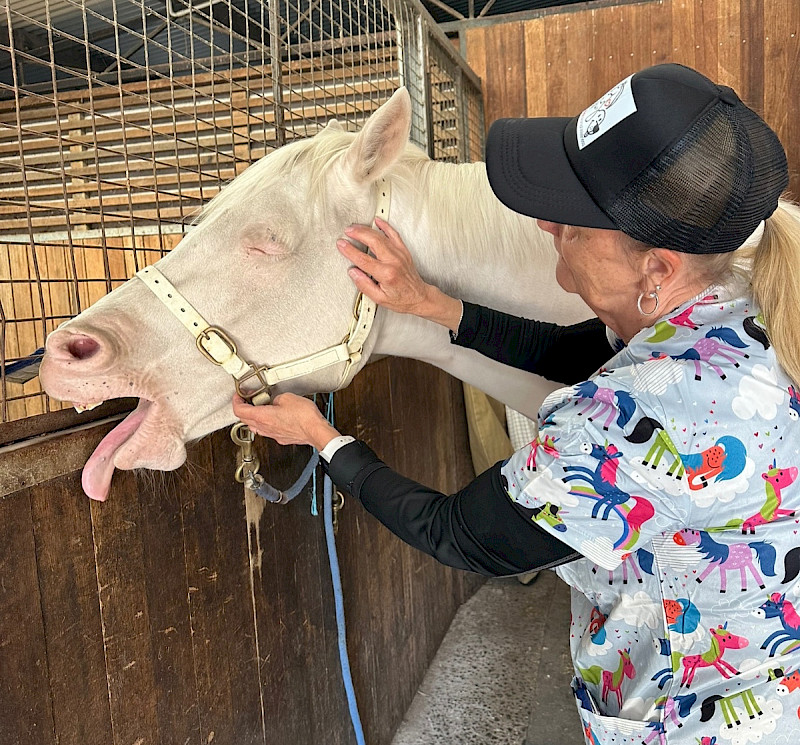
The other major strand of Susan’s work brings together her love of animals and her interest in holistic wellbeing.
People may approach her when they are concerned about changes in an animal’s behaviour or wellbeing, or simply feel that something is not quite right.
Susan is careful to position this work as complementary to appropriate veterinary care rather than a replacement for it.
She uses gentle energy-based approaches with the aim of supporting relaxation, comfort and overall wellbeing, while acknowledging that the proposed mechanisms behind energy therapies are not scientifically established.
It is perhaps this willingness to hold curiosity and professional responsibility at the same time that sums up Susan’s wider philosophy particularly well.
There is room to explore.
There is room to ask questions.
And there should always be room to recognise the limits of what we know.
From practitioner to educator
Becoming a trainer felt like a natural progression for Susan.
After years of developing her own knowledge, she wanted to help aspiring practitioners develop theirs too.
“I love sharing knowledge, encouraging others to explore their own abilities and helping aspiring practitioners develop the confidence and skills to make a meaningful difference.”
That ongoing learning is also what keeps Susan passionate about her own work.
Whether she is seeing something click for a student or watching a client approach a challenge from a completely different perspective, she says those moments of possibility are what make the work rewarding.
“For me, this has never been just a career. It’s a genuine passion, and I can’t imagine ever reaching a point where I feel I’ve learned enough or have nothing more to share.”
Why IPHM?
Professionalism is an important part of that journey.
Susan joined IPHM because she wanted professional recognition alongside a community that embraces the breadth of complementary and holistic practice.
As both a practitioner and training provider, she believes accreditation helps demonstrate a commitment to professional standards, integrity and continued development.
It also gives prospective clients and students another way to feel confident about who they choose to work or train with.
For Susan, though, membership is also about connection.
It means being part of an international community of practitioners and educators who may work in very different modalities but share many of the same values.
Susan’s advice to anyone starting out
After more than twenty years of exploring holistic wellbeing, Susan’s advice is fittingly simple:
Stay curious.
You do not need to know everything before you begin.
You do not need to force yourself into one rigid way of working.
Take your time. Ask questions. Keep learning. Explore what resonates while maintaining a healthy sense of discernment.
And, as Susan puts it:
“You don’t have to have all the answers to take that first step.”
That might be advice for new practitioners.
But perhaps it is useful for all of us.
Disclaimer
The content published on this blog is for informational and educational purposes only. It represents the views and experiences of the author(s) and is not intended to replace professional medical advice, diagnosis, or treatment.
Discussions of natural, complementary, or alternative therapies are shared as personal or anecdotal experiences unless otherwise supported by credible scientific evidence. These are not claims of cure or guaranteed results.
Readers are strongly encouraged to consult qualified healthcare professionals before making any decisions related to their health or well-being. IPHM does not endorse specific therapies, products, or practitioners unless explicitly stated.
By engaging with this content, you acknowledge that any reliance on the information provided is at your own risk.